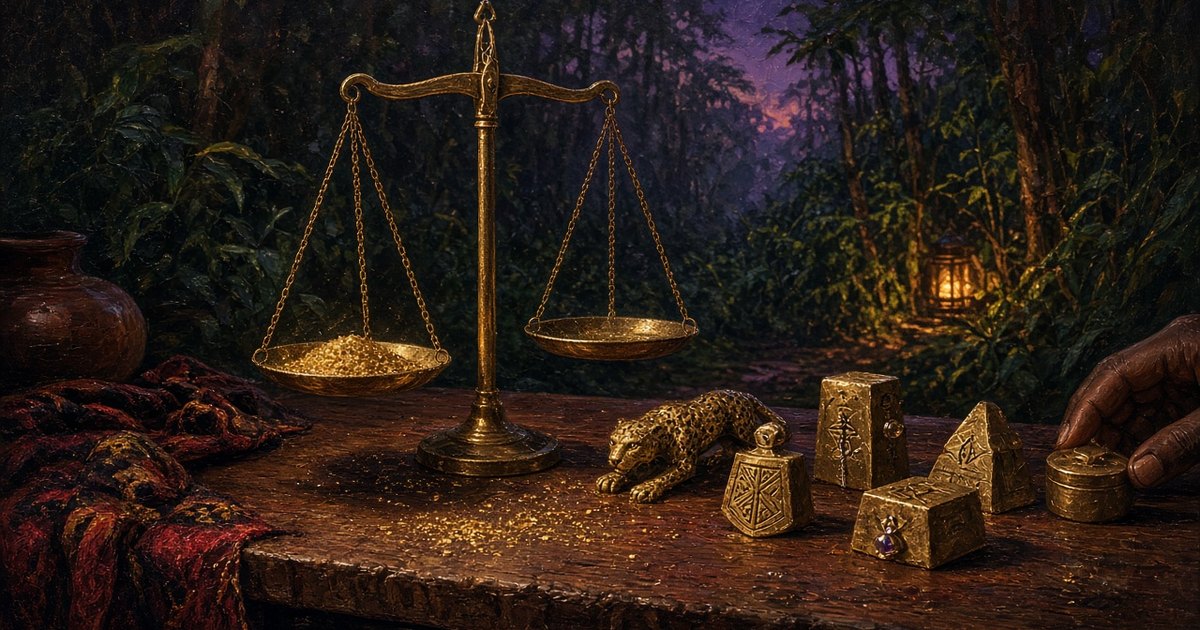

At Mapungubwe they buried a rhino of gold. Inside, it was wood
A golden rhino, a kingdom on a hill, and what is under your numbers
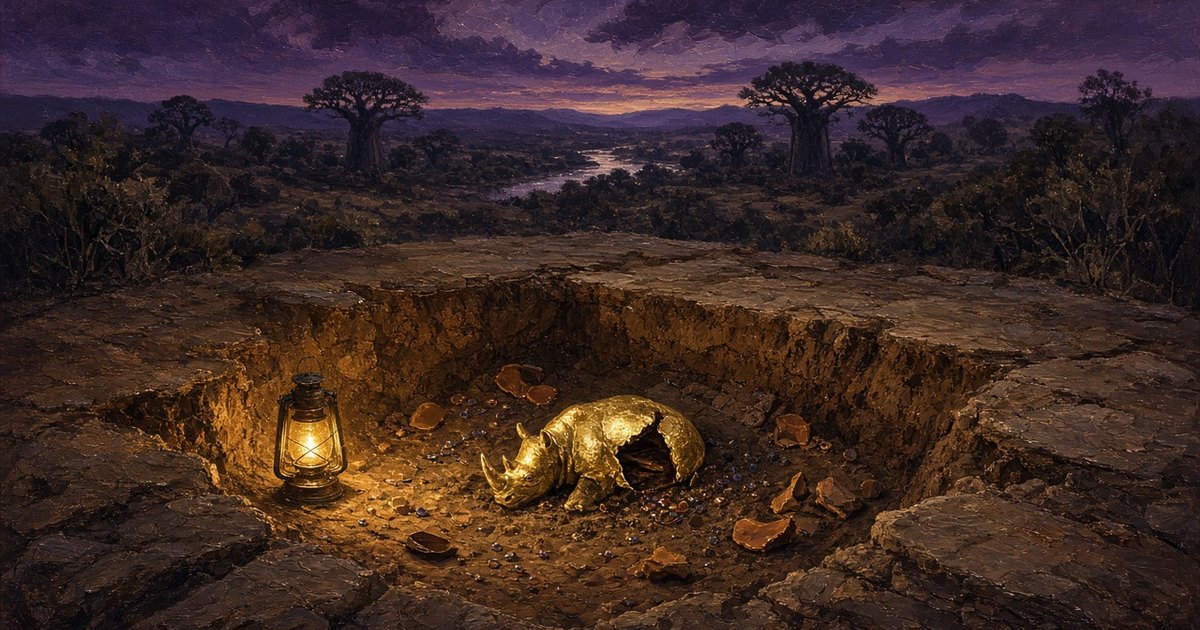
In the early 1930s a small party climbed a steep sandstone hill near the point where the Shashe River meets the Limpopo, where South Africa, Botswana and Zimbabwe now touch. On the flat summit they found graves. In one of them lay a rhinoceros small enough to stand in the palm of your hand, shining with gold.
It looked like a solid gold treasure. It was not. The golden rhinoceros of Mapungubwe is a carved wooden figure covered in thin sheets of gold. The value you could see was a skin. The shape underneath was wood.
A kingdom on a hill
The hill is called Mapungubwe, usually explained as "a place of (many) jackals". Its original name is not known. Around the year 1000, farming and herding people from the Leopard's Kopje culture settled in the valley below, at a site archaeologists call K2. They grew sorghum and millet, worked iron and copper, and ran large cattle herds that grazed on neighbouring communities' land, which tied those communities into relationships with them.
The region was wetter then than it is now. The Limpopo flooded and fed the soil. Food was plentiful and the population grew.
Their wealth, though, came from a network as much as from the land. Ivory and gold from the interior went east to the Swahili trading towns on the Indian Ocean coast. Glass beads, cloth and glazed ceramics came back. Over two centuries that trade made some families far richer than others.
Around 1220, during a drier period, the ruling elite moved up onto the hill and the rest of the people settled on the land below. Archaeologists describe it as one of the earliest known class-based societies in southern Africa: the rulers above, everyone else beneath. The hill was also a rainmaking site, so living on it tied the leader's power to the rain itself. By around 1250 the capital may have held about 5,000 people.
Then, around 1300, after events that are still not fully understood and as trade routes shifted north, the people of Mapungubwe moved away. The centre of gravity in the region passed to places like Great Zimbabwe. The hill was left with its graves.
Found, and then kept out of sight
Local people always knew Mapungubwe was a sacred hill. Outsiders "discovered" it only when the gold came out of the ground in 1932 and 1933. The University of Pretoria secured research rights and dug there for years.
What happened next is part of the lesson. For decades, the university's own account notes, the excavations and findings were largely held within academia and rarely reached the public. Some of the richest evidence of an African state in southern Africa sat in storerooms while the official story of the country left it out. Only after the 1990s did Mapungubwe become a national park, a National Heritage Site in 2001 and a UNESCO World Heritage Site in 2003. The golden rhino later became a national symbol and travelled to the British Museum in 2016.
The knowledge existed the whole time. It just was not shared, so it did not shape what people believed.
What Mapungubwe teaches a business today
Know what is under the gold. The rhino is beautiful because of a thin outer layer. Many businesses look the same way: a polished dashboard, a confident monthly report, a glossy pitch deck. Ask what the shine is fastened to. Is the stock figure built from counted lots, or from last month's figure plus a guess? Is the yield number recorded at the line, or typed in at the end of the week? The finish is worth only as much as the structure beneath it.
Wealth came from the network, not the hill. Mapungubwe did not sit on a gold mine. It sat on a confluence, where cattle, crops, interior gold and ivory, and coastal trade met. Its herders even grazed on other communities' land and turned that into relationships. In industry, the plant that wins is rarely the one with a single lucky asset. It is the one that connects suppliers, quality, production and customers so that value can flow between them.
Conditions change before the story does. The kingdom grew in a wet period and reorganised in a drier one. Then trade moved north. None of this happens overnight, but the signals come early: a supplier's quality drifting, a market buying elsewhere, rainfall falling season after season. You only see the drift if you keep the record over time.
Knowledge in a storeroom changes nothing. Mapungubwe's evidence was dug up, catalogued and then mostly kept out of public view for decades. Every company has its own storerooms: the spreadsheet only one person opens, the quality log nobody reviews, the sensor data that never leaves the machine. Data that is not shared with the people making decisions might as well still be underground.
This is why, at Tamalaki, we build FactoraERP and FactoraIoT around one shared record. Lots, checks, costs and machine readings should sit where the people running the plant can see them, so the number on the report is fastened to something real.
So here is my question for you this week: if you scraped the gold off your most-quoted business number, what would you find underneath it?
Sources
- Wikipedia, "Kingdom of Mapungubwe" (Shashe–Limpopo confluence; K2/Bambandyanalo c.1000; Leopard's Kopje; crops, iron and copper; cattle grazed on other communities' land; wetter period 1000–1200; Indian Ocean trade via Swahili towns; elite moved onto the hill c.1220 in a dry period; rainmaking hill; population c.5,000 by 1250; departure c.1300 as trade routes shifted north; local knowledge of the sacred site; name meaning "place of jackals"): https://en.wikipedia.org/wiki/Kingdom_of_Mapungubwe
- Wikipedia, "Golden rhinoceros of Mapungubwe" (wood covered in thin sheets of gold; found on a royal grave on Mapungubwe Hill in 1932 by University of Pretoria archaeologists; "small enough to stand in the palm of your hand"; British Museum display 2016–17): https://en.wikipedia.org/wiki/Golden_rhinoceros_of_Mapungubwe
- Wikipedia, "Mapungubwe Collection" (University of Pretoria research rights 1933; excavations 1933–40 and later; findings "largely held within academia and rarely reached public knowledge"; earliest southern African state at Mapungubwe Hill c.1220–1290): https://en.wikipedia.org/wiki/Mapungubwe_Collection
- Wikipedia, "Mapungubwe National Park" (park proclaimed 1998; National Heritage Site 2001; UNESCO World Heritage List 2003): https://en.wikipedia.org/wiki/Mapungubwe_National_Park
- UNESCO World Heritage Centre, "Mapungubwe Cultural Landscape": https://whc.unesco.org/en/list/1099/
Originally published at isaacmuthui.com.
Comments
Join the discussionNo comments yet. Be the first to comment.