

The Akan Weighed Their Money in Brass. Every Trader Carried the Standard
Trust is a standard both sides can check, calibration never stops, and the measure belongs where the work happens
By Isaac Muthui, Founder & CEO, Tamalaki Business Network Ltd
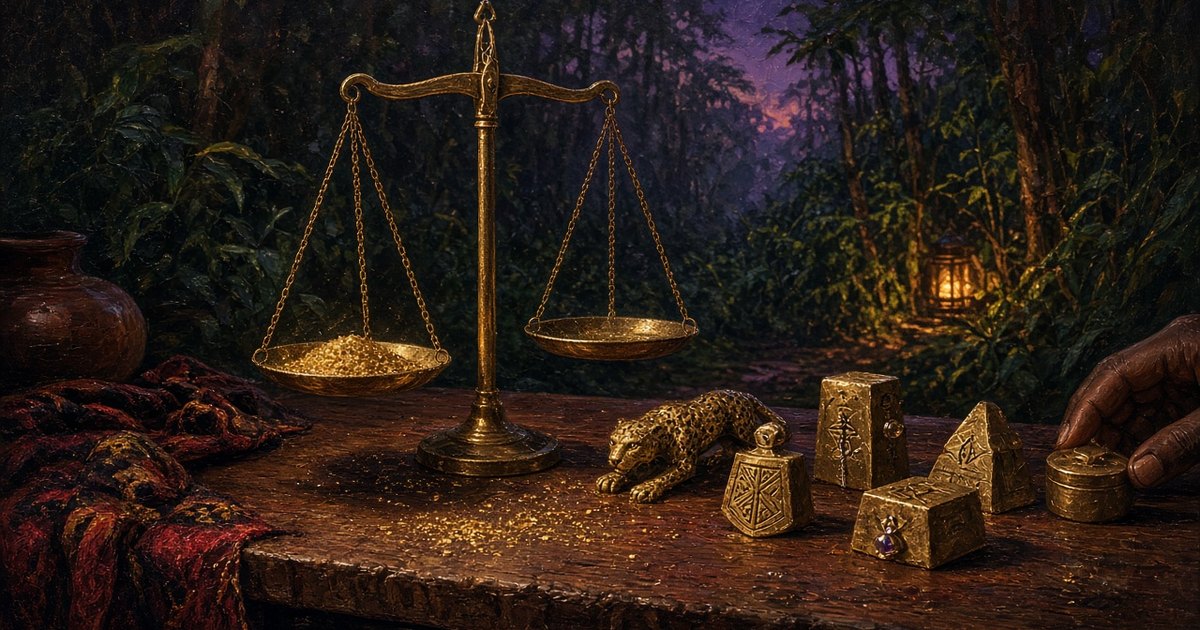
Pick one up in a museum case and it fits in the palm of your hand. A tiny brass leopard. A shield. A double-edged sword. A neat little block cut with lines, like a seal. Most weigh less than about two and a half ounces. Visitors lean in and see miniature sculpture.
The people who made them saw money. Or, more exactly, they saw the thing that made money trustworthy.
These are Akan goldweights, called mrammou or abrammuo, from the forest country of what is now Ghana and Côte d'Ivoire. For centuries the Akan, and later the Asante kingdom, traded in gold dust. Gold dust was the main currency of Asante, and from the early eighteenth century it was its legal tender. You did not count gold dust. You weighed it. And to weigh it, you needed a scale and a set of weights that both sides of a deal could believe.
A currency you had to measure
Imagine buying cloth, salt or a gun with a pinch of powder. The value of the deal depends entirely on how much powder is in the pan. Lean on the scale, and you cheat. Use a weight that is a little light, and you cheat quietly, every day, for years.
The Akan answer was to make the standard itself an object of skill and pride. Goldsmiths cast the weights in brass using the lost-wax method: model the form in wax, cover it in clay, melt the wax out, and pour in the metal. Then came the part that mattered most. Each weight was checked. If a casting came out too heavy, the smith would file it down, and even a beautiful figure might lose a horn or a limb to meet its value. If it was too light, the smith added small lead rings or glass beads until it reached the standard.
Researchers who have measured surviving weights report that most fall within about 3% of their intended value, a range they compare with European nested weights of the same era. That is a remarkable result for objects that were also works of art. Beauty came second. Accuracy came first.
Every trader carried the standard
There was no single central weights office stamping each piece. Weights belonged to people. A merchant kept his own scale and his own set of weights. A complete set raised a man's standing, and small complete sets were given to newly married men so that they could enter trade respectably.
The system was large. Scholars have recorded more than sixty weight values in a full Akan series, with names that differed from place to place; the historian Timothy Garrard documented twelve separate name lists across Ghana and Côte d'Ivoire. Estimates of how many weights were cast between about 1400 and 1900 run into the millions, though nobody can count them exactly.
The oldest weights are geometric. Figures of people, animals, tools and buildings appear from around 1600. And many of those figures meant something. A weight could stand for a proverb, a story or a rule of conduct. Equality and justice sit at the heart of Akan thinking, and the weights carried those ideas into the market. The writer Kwame Anthony Appiah has described how his mother, who collected goldweights, heard the proverbs that each figure called up, and the Anansi stories behind them.
Think about that. The tool that kept the deal honest also reminded you, while you used it, why honesty mattered.
When the standard fell away
By the late nineteenth century, the quality of the weights, both their design and their metal, had declined. As coin and paper replaced gold dust as money, the weights lost their daily use and were abandoned. Today many are sold to tourists as mass-produced copies that look like the old ones but carry neither the accuracy nor the proverbs.
The objects survived. The system around them did not.
What the goldweights teach a business today
Every business runs on measurement it rarely thinks about. How much did we receive? How much did we use? How much did we ship? How long did the line run? Most arguments between departments, and between companies, are really arguments about whose scale to believe.
The Akan goldweights point to four lessons.
Trust is a standard both sides can check. A deal is only as fair as the measurement underneath it. When a supplier, a customer and your own team each keep a different number for the same delivery, you do not have a trust problem. You have a measurement problem. Agree on one record and make it easy for everyone to check.
Calibrate, then keep calibrating. The goldsmith did not assume the casting was right. He weighed it, and filed or added until it was. Scales drift, sensors drift, and spreadsheets drift fastest of all. Build the check into the work: weigh, compare, correct, and note who did it.
Put the standard where the work happens. Akan traders carried their weights with them. The measurement was present at the moment of the deal, not in an office days later. In a factory or a warehouse, that means recording quantities and conditions at intake, on the line and at dispatch, not at the end of the week from memory.
Let your measures carry your values. The weights were proverbs as well as tools. What you choose to measure tells your people what you care about. If you only measure output, you will get output. If you also measure quality, waste and safety, and name who is responsible, your numbers start to teach.
This is the work I care about most at Tamalaki. When we build systems such as FactoraERP, the hardest part is rarely the software screen. It is agreeing on the standard: what a lot is, when it is weighed, who confirms it, and how the record follows it from intake to dispatch. Get that right and the rest of the system has something honest to stand on.
The Akan goldweights lost their purpose when the money changed. The lesson did not. Whatever your currency, someone has to hold the standard.
For builders: your system is a set of goldweights
Every system you build rests on measurements someone has to trust: a stock count, a sensor reading, a latency number, a row count after a migration. The Akan goldsmith's habit translates directly.
- One standard, checkable by both sides. If two services compute "available stock" differently, they will disagree in production. Define the measure once and expose it so others can verify it.
- Calibrate in the loop. Reconcile counts, compare sensor readings against a reference, and alert on drift. Don't assume the casting came out right.
- Measure at the point of work. Capture data where the event happens (intake, the line, dispatch), with who and when, not in a batch job reconstructing it days later.
- Record the adjustment. The smith's lead rings and filed edges are visible. Your corrections should be too: an audit trail, not a silent overwrite.
So here is my question for you this week: if your biggest customer asked tomorrow how you measured their last order, could you show them, and would they believe your scale?
Sources
- Wikipedia, "Akan goldweights" (names mrammou/abrammuo; status of complete sets and gift sets for newly married men; Early c.1400–1720 and Late c.1700–1900 periods; geometric weights oldest, figurative from c.1600; estimate of around 4 million cast, described as supposition; more than sixty values and Garrard's twelve name lists; lost-wax casting, filing, lead rings and glass beads; most weights under 2½ oz and within 3% of theoretical value, compared with European nest weights; decline by the 1890s; Appiah quotation context): https://en.wikipedia.org/wiki/Akan_goldweights
- Wikipedia, "Economy of the Ashanti Empire" (gold dust as main currency and legal tender from the early 18th century, under Osei Kofi Tutu I): https://en.wikipedia.org/wiki/Economy_of_the_Ashanti_Empire
- Kwame Anthony Appiah, In My Father's House (1992), on his mother's goldweight collection, as quoted in the Wikipedia article.
- Timothy F. Garrard, Akan Weights and the Gold Trade (Longman, 1980).
Comments
Join the discussionNo comments yet. Be the first to comment.